The Comportance Framework
The Comportance Framework
The Comportance Framework
A product design framework that allows combining strategic thinking, behavioural design, goal-setting, validation and iterative execution into one meaningful flow.
A product design framework that allows combining strategic thinking, behavioural design, goal-setting, validation and iterative execution into one meaningful flow.
Applicable on any level - from full product design to small feature updates
Applicable on any level - from full product design to small feature updates
About the Author
Tetiana Kobzar
After 20 years of building software products, using different productivity frameworks, Agile principles, and applying gamification and behavioural design in product development, Tetiana realized that the product development process parts are usually disconnected, and teams miss clarity on crucial questions.
That's how Comportance was created — to fill those gaps, help teams stay aligned, and bring clarity and thoughtfulness to every step.

The Problems
What Comportance Solves
What Comportance Solves
What Comportance Solves
Unclear goals
Teams start projects without knowing why or what success looks like
Unmeasurable outcomes
No specific metrics, no definition of done, just "let's see what happens"
Missing baseline
Trying to improve without knowing the current state you're improving from
Feature-driven, not people-driven
Ignoring user motivation, emotion, and behavioral drivers
Hypothesis overload
Testing everything at once instead of validating one clear bet at a time
Endless iteration
No decision points, no stop criteria, no clear evaluation cadence
The Problems
What Comportance Solves
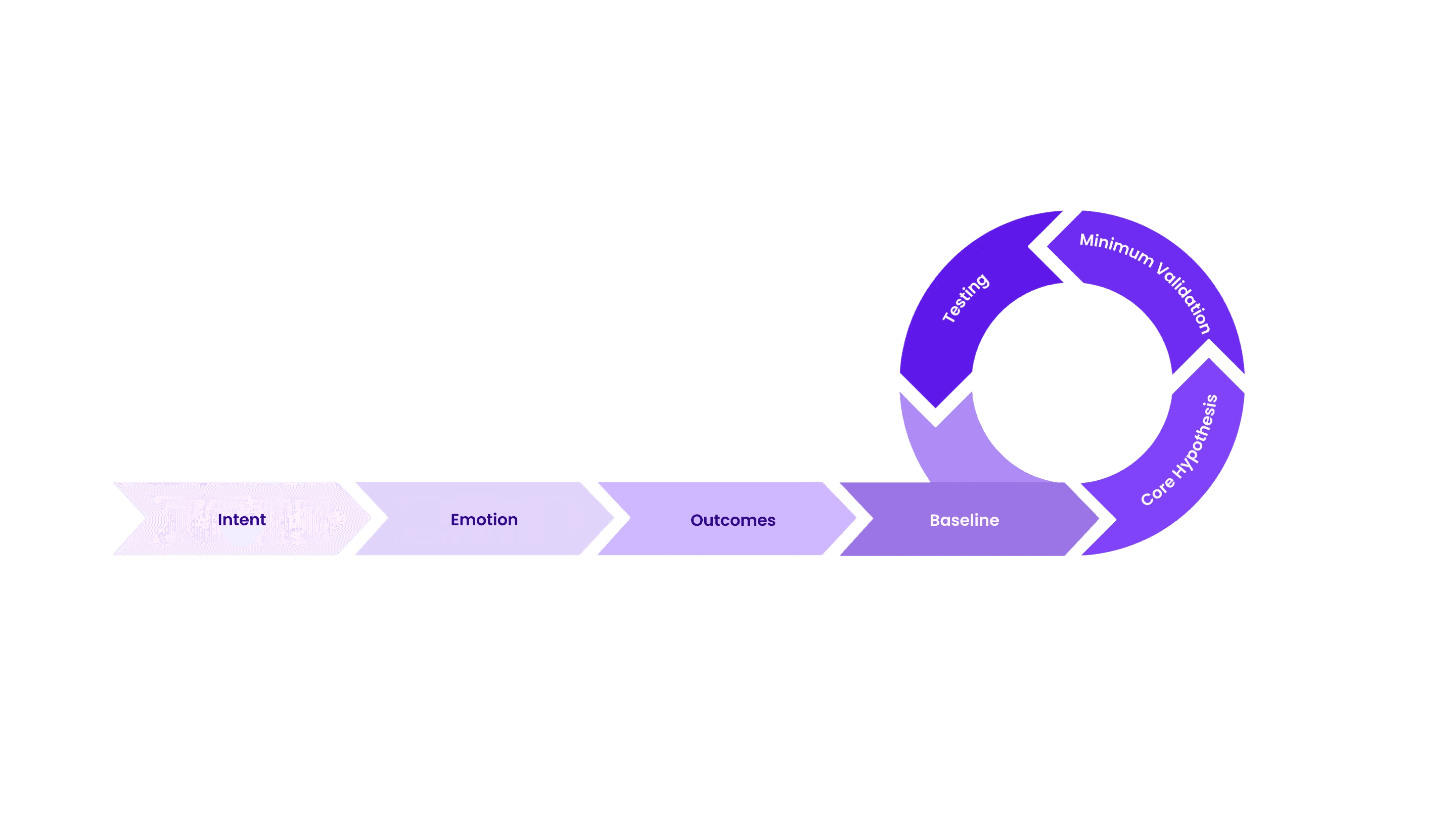
1.
Intent
Why are we doing this?
Always start with “Why?” Usually it comes to one of two:
• What problem are we trying to solve? or
• What goal are we trying to achieve?
Don’t forget to think about these questions for both your organisation and your product or solution users.
2.
Outcomes
How should users feel?
Human-centred design optimises the system according to users' feelings and reasons why they do or don’t do certain things, making them motivated to use our solution.
• What emotional states do we want users have? (calm, confident, energized, etc.)
• What motivational drives do we want to focus on? (progress, mastery, belonging, control, etc.)
User decisions are driven by emotion and motivation, not just logic and the better you understand your users, the more motivated and loyal they will be.
3.
Emotional Experience
What does success look like?
How can we say we reached the goal we defined in step 1? Be specific, follow SMART or OKRs approach. Desired outcomes should be specific, measurable and achievable.
4.
Behavioural Baseline
What is happening today?
Before you change anything, measure where you're starting from. Make sure you are measuring the same metrics that you set up as a goal in the Outcomes Step. That wil allow you to follow the progress and adjust the next steps more easily.
This step can reveal some additional problems. This step is also often missed during the planning
You cannot improve what you are not measuring.
5.
Core Hypothesis
What is our bet?
Even if you have a lot of great ideas, validate them one by one. Choose one hypothesis, focus on it, and test it before moving on to the next. It will help to crystallise the actions, planned functionality
Make the hypothesis clear and thoughtful.
Format: "If we [do X] for [Y audience], we expect [Z change] because [reasoning based on behavior/motivation/evidence]."
One hypothesis. Not three, not five. Pick one and test it.
6.
Minimum Validation
What's the simplest test?
Follow the MVP principle - what's the fastest, lightest, but still meaningful and valuable for users way to test your hypothesis?
Start with the simplest idea implementation, validate it, improve based on the users feedback or the hypothesis validation process.
7.
Cadence
When and how do we evaluate?
Set clear timelines and decision criteria.
• When do we start?
• When do we check results?
• What defines success? (specific thresholds)
• What defines failure?
• Decision framework:
• Go: Validated - continue to develop this hypothesis, or if the goal is fully achieved, move to the next goals
• Adjust: Learned something - pivot and test again
• Stop: Not working - move on, try the different hypotesis
No open-ended "let's see how it goes." Set the rules upfront.
The Problems
What Comportance Solves
1.
Intent
Why are we doing this?
Always start with “Why?” Usually it comes to one of two:
• What problem are we trying to solve? or
• What goal are we trying to achieve?
Don’t forget to think about these questions for both your organisation and your product or solution users.
2.
Outcomes
How should users feel?
Human-centred design optimises the system according to users' feelings and reasons why they do or don’t do certain things, making them motivated to use our solution.
• What emotional states do we want users have? (calm, confident, energized, etc.)
• What motivational drives do we want to focus on? (progress, mastery, belonging, control, etc.)
User decisions are driven by emotion and motivation, not just logic and the better you understand your users, the more motivated and loyal they will be.
3.
Emotional Experience
What does success look like?
How can we say we reached the goal we defined in step 1? Be specific, follow SMART or OKRs approach. Desired outcomes should be specific, measurable and achievable.
4.
Behavioural Baseline
What is happening today?
Before you change anything, measure where you're starting from. Make sure you are measuring the same metrics that you set up as a goal in the Outcomes Step. That wil allow you to follow the progress and adjust the next steps more easily.
This step can reveal some additional problems. This step is also often missed during the planning
You cannot improve what you are not measuring.
5.
Core Hypothesis
What is our bet?
Even if you have a lot of great ideas, validate them one by one. Choose one hypothesis, focus on it, and test it before moving on to the next. It will help to crystallise the actions, planned functionality
Make the hypothesis clear and thoughtful.
Format: "If we [do X] for [Y audience], we expect [Z change] because [reasoning based on behavior/motivation/evidence]."
One hypothesis. Not three, not five. Pick one and test it.
6.
Minimum Validation
What's the simplest test?
Follow the MVP principle - what's the fastest, lightest, but still meaningful and valuable for users way to test your hypothesis?
Start with the simplest idea implementation, validate it, improve based on the users feedback or the hypothesis validation process.
7.
Cadence
When and how do we evaluate?
Set clear timelines and decision criteria.
• When do we start?
• When do we check results?
• What defines success? (specific thresholds)
• What defines failure?
• Decision framework:
• Go: Validated - continue to develop this hypothesis, or if the goal is fully achieved, move to the next goals
• Adjust: Learned something - pivot and test again
• Stop: Not working - move on, try the different hypotesis
No open-ended "let's see how it goes." Set the rules upfront.
The Problems
What Comportance Solves
1.
Intent
Why are we doing this?
Always start with “Why?” Usually it comes to one of two:
• What problem are we trying to solve? or
• What goal are we trying to achieve?
Don’t forget to think about these questions for both your organisation and your product or solution users.
2.
Outcomes
How should users feel?
Human-centred design optimises the system according to users' feelings and reasons why they do or don’t do certain things, making them motivated to use our solution.
• What emotional states do we want users have? (calm, confident, energized, etc.)
• What motivational drives do we want to focus on? (progress, mastery, belonging, control, etc.)
User decisions are driven by emotion and motivation, not just logic and the better you understand your users, the more motivated and loyal they will be.
3.
Emotional Experience
What does success look like?
How can we say we reached the goal we defined in step 1? Be specific, follow SMART or OKRs approach. Desired outcomes should be specific, measurable and achievable.
4.
Behavioural Baseline
What is happening today?
Before you change anything, measure where you're starting from. Make sure you are measuring the same metrics that you set up as a goal in the Outcomes Step. That wil allow you to follow the progress and adjust the next steps more easily.
This step can reveal some additional problems. This step is also often missed during the planning
You cannot improve what you are not measuring.
5.
Core Hypothesis
What is our bet?
Even if you have a lot of great ideas, validate them one by one. Choose one hypothesis, focus on it, and test it before moving on to the next. It will help to crystallise the actions, planned functionality
Make the hypothesis clear and thoughtful.
Format: "If we [do X] for [Y audience], we expect [Z change] because [reasoning based on behavior/motivation/evidence]."
One hypothesis. Not three, not five. Pick one and test it.
6.
Minimum Validation
What's the simplest test?
Follow the MVP principle - what's the fastest, lightest, but still meaningful and valuable for users way to test your hypothesis?
Start with the simplest idea implementation, validate it, improve based on the users feedback or the hypothesis validation process.
7.
Cadence
When and how do we evaluate?
Set clear timelines and decision criteria.
• When do we start?
• When do we check results?
• What defines success? (specific thresholds)
• What defines failure?
• Decision framework:
• Go: Validated - continue to develop this hypothesis, or if the goal is fully achieved, move to the next goals
• Adjust: Learned something - pivot and test again
• Stop: Not working - move on, try the different hypotesis
No open-ended "let's see how it goes." Set the rules upfront.
Science and Experience Behind
What Makes Comportance Different
What Makes Comportance Different
What Makes Comportance Different
Comportance was created after 20 years of building software products and using different product frameworks along the way. Most of them excel at one thing - they go deep on a specific aspect of product development, and that depth is valuable. But here's the problem: real product work requires all of these perspectives at once.
Comportance was created after 20 years of building software products and using different product frameworks along the way. Most of them excel at one thing - they go deep on a specific aspect of product development, and that depth is valuable. But here's the problem: real product work requires all of these perspectives at once.
Cadence
Framework Type
Empathy & Research
Jobs-to-be-Done,
User Story Mapping, Empathy Maps
The Gap
Don't connect understanding to behavioural psychology or concrete metrics
Comportance Step
Step 1 (Intent)
Behavioural Design
Empathy & Research
Octalysis, Hooked Model, BJ Fogg's Behavior Model
Jobs-to-be-Done,
User Story Mapping, Empathy Maps
Skip the "why are we building this" and "how do we measure success" questions
Don't connect understanding to behavioural psychology or concrete metrics
Step 2 (Emotion)
Step 1 (Intent)
Behavioural Design
Octalysis, Hooked Model, BJ Fogg's Behavior Model
Skip the "why are we building this" and "how do we measure success" questions
Step 2 (Emotion)
Goal-setting
OKRs, SMART goals
Don't connect metrics back to user emotion or the hypothesis being tested
Step 3 (Outcomes)
Validation
Lean Startup, Design Sprints
Leave teams unclear on emotional experience or baseline they're improving from
Steps 5–6 (Hypothesis & Validation)
Execution
Scrum, Kanban, Shape Up
Assume you already know what to build and why
Step 7 (Cadence)
Comportance doesn't care which tools you use. It just makes sure you don't skip the essential questions at each stage.
Cadence
Framework Type
The Gap
Comportance Step
Empathy & Research
Jobs-to-be-Done,
User Story Mapping, Empathy Maps
Don't connect understanding to behavioural psychology or concrete metrics
Step 1 (Intent)
Behavioural Design
Octalysis, Hooked Model, BJ Fogg's Behavior Model
Skip the "why are we building this" and "how do we measure success" questions
Step 2 (Emotion)
Goal-setting
OKRs, SMART goals
Don't connect metrics back to user emotion or the hypothesis being tested
Step 3 (Outcomes)
Validation
Lean Startup, Design Sprints
Leave teams unclear on emotional experience or baseline they're improving from
Steps 5–6 (Hypothesis & Validation)
Execution
Scrum, Kanban, Shape Up
Assume you already know what to build and why
Step 7 (Cadence)
Comportance doesn't care which tools you use. It just makes sure you don't skip the essential questions at each stage.
Applications
You Can Use It For
You Can Use It For
You Can Use It For
Comportance makes you get clear before you build. It doesn't guarantee success, but it dramatically increases the odds that you're building something that matters, for people who need it, with a clear way to know if it's working.
That's it. No magic, just clarity.